Thinking-Drinking
  • Blog
  • Erin
  • Index
  • Articles
  • News
  • Contact

Certifiable : A play about a sommelier...

8/14/2013

1 Comment

 
Picture
It's rare that you see sommeliers portrayed in the arts, and when you do, they are usually stiffly dressed with a white tablecloth over the arm-- present as a prop more than a character. 

But head to this years Fringe Festival, and you will find a sommelier in the spotlight. The play, Certifiable, by Molly Rydzel, is a touching story of a sommelier, the love of her life, and his new wife. 
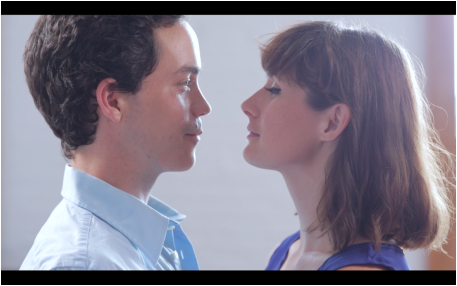
PictureKett Turton and Crystal Arnette play the roles of Greg and Pam
The plot takes us through the raw and bumpy relationship between Pam (our sommelier) and Greg (a successful banker). They fall deeply in love, and as Pam studies for her sommelier certification, Greg helps her hit the books. During their courtship, sommeliers in the audience might sigh with nostalgia as they drink certain bottles (like an '82 DRC). But it's not always easy for this couple because Pam has a mental illness that causes her to drift into scary places when she doesn't take her meds. Greg is very supportive, but has to leave when she pushes him over the edge.  


He ends up marrying the Stepfordesque Marianne. Marianne is sweet, loving, and faithful; but Greg still has feelings for Pam, who haunts their relationship. 

PicturePlaywright & Sommelier Molly Rydzel
The playwright, Molly Rydzel works as a sommelier and knows how to make all the right jokes. You will crack up when Greg's new wife, Marianne, orders a glass of pinot grigio with a side of ice, or when she talks about 'serious gourmet food, like risotto.' You want to slap this woman when you hear her dismissively speak to the waitstaff. When Pam drinks some leftover sips of wine bottles sold that evening, you might recognize a bottle of Haut-Brion on the bar-top. And when Greg helps Pam study for her sommelier exams, your adrenaline will kick in as you watch her recall the certified grape varieties grown in the major regions of France. You may even commiserate when she slams her wine study book closed while vociferously cursing. 



PictureGreg and Pam


Your heart will melt a little when you watch Greg fall in love with Pam, especially when he proclaims, "You've shown me this whole other world of wine! Now that I know all of this exists, I'm never gong back!" And when things don't work out with Pam, you feel sorry for him when you know he is drinking cheap pinot grigio at his wife's dinner party. 

PictureNeka Zang plays the roll of Marianne
But despite Marianne's shallowness, her character development is so interesting. She turns out to be a powerful lady who courageously confronts Pam on several occasions to defend her marriage to Greg. You end up really feeling for this poor woman when she goes to visit Pam in the hospital and unwittingly discovers a betrayal by her husband. And when the play ends, it is Marianne who has lost everything. 

In the restaurant business, I've worked closely with the playwright, Molly Rydzel, and I watched her work towards and achieve her own sommelier certification. Over the years I've been amazed at how she has managed to balance her theater career with her restaurant career- she'd never miss a sommelier shift despite writing all morning and rehearsing all afternoon! I've been impressed with her passion for wine, and her skill at working on the restaurant floor. I was so excited to see Certifiable on opening night; Molly's enthusiasm for wine truly shines through the script. 

Molly also has a fascination with the mind, and this play explores not only the life of a sommelier, but the life of someone with severe mental illness. If you have ever had someone close to you with schizophrenia, your heart will ache as you watch Pam attempt to determine what around her is real and what is imagined. Crystal Arnette owns this role and performs it with an eerie elegance. 

Wine, love, and drama-- these threads weave themselves through all of our lives, and you can find them on stage through August 24th, 2013. 

Now playing at the Connolly Theater on 4th Street:
FRI 8/16 @ 9:30-11:00 
 SUN 8/18 @ 4:15-5:45 
 THU 8/22 @ 4:30-6:00 
 SAT 8/24 @ NOON-1:30
Tickets: 866 468 7619
1 Comment

A Tea Post from Kathy YL Chan

8/12/2013

1 Comment

 
Picture
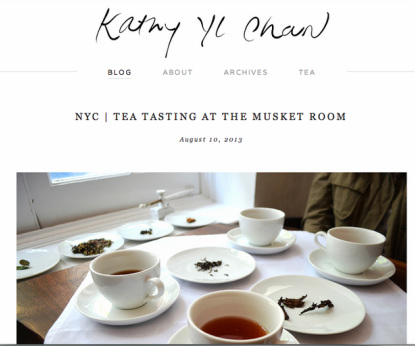
Tea expert and food writer Kathy YL Chan just posted a lovely article on her blog about the tea program at The Musket Room. 

When I first conceived of this tea list, I wanted a special selection that would reflect some of the interesting global teas that I've been impressed by over the years. The list turned out to be a global mix of white, green, rare oolong, and pu-ehr teas from China, domestic tea from North Carolina (yaupon), herbal teas from the Musket Room's backyard garden, and some house-made chai. 

Kathy popped in one morning for a tea tasting; click here to read her notes!

1 Comment

Linden "Claret" 2010 (Linden, Virginia)

8/8/2013

0 Comments

 
Picture
Winegrower Jim Law is one of the great producers in Virginia, growing grapes in the Blue Ridge Mountains since the early 1980s. Inspired by his experience teaching agriculture as a Peace Corps volunteer in Zaire, he did stints at several wineries before settling in at Linden about 30 years ago.

I've been drinking his wines for almost a decade now, and they are very special. Right about now his earliest plantings are coming into a beautiful maturity, and this-- combined with great winemaking-- translates to complexity in the glass. The newer plantings went in at much higher density; it will be exciting to see how this plays out in the glass. 

His Hardscrabble chardonnay is full of depth and richness and drinks like a white Burgundy; his Hardscrabble red is stunning when you have it at the right age-- a few months ago I opened up an '06 and it blew me away.

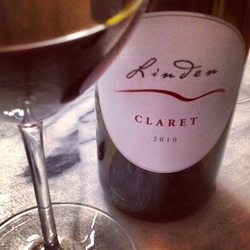
More recently, I had this 2010 Claret which blends fruit from three of his vineyards: Hardscrabble, Avenius, and Boisseau. 

Picture


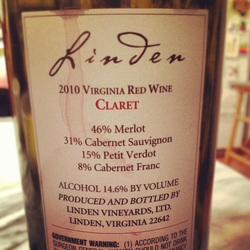
The blend is:
46% Merlot
31% Cabernet Sauvignon
15% Petit Verdot
8% Cabernet Franc

2010 was an unusually great vintage in Virginia (especially for reds), lauded by every winemaker I've had a chance to meet with. 

Picture
This wine was rich and age worthy. I definitely opened this a bit too early. I pushed the rest of the bottles to the back of my cellar and I cannot wait to try this same wine 5 or 6 years from now. Still, the great winemaking was obvious and the way the blend came together was a lovely harmony. 

The single vineyard bottlings from Linden come in at almost twice the price as this Claret, and if the quality of this wine is any indication of what the single vineyard sites might be like, I cannot wait to be amazed by them. 

Something very special is happening at this Virginia winery! 

0 Comments

Tradition, Language, and a Vertical of Bartolo Mascarello

8/3/2013

0 Comments

 
Picture
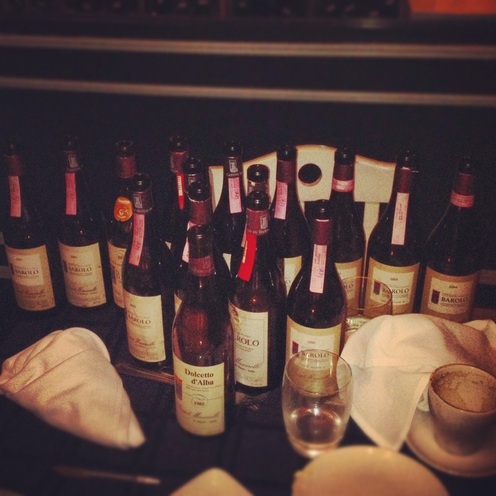
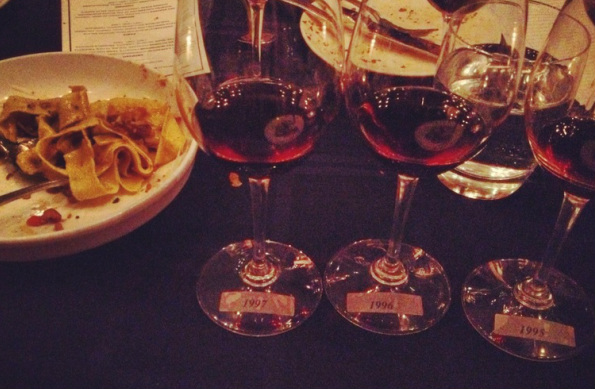
A few months back I went to a vertical tasting of Bartolo Mascarello Barolo at L'Artusi. We tasted 1987 through 2005, and it was really interesting to experience the state of the wines as they change over time. 

Different styles of Barolo have emerged over the last several decades. One is based on swift maceration and aging in small oak barrels, creating a richer, oakier wine. Another is based on long maceration and elevage in large local oak and chestnut barrels. Bartolo Mascarello (c.1927-2005) stuck to the second, "traditional," style of Barolo-- learned from his father and continued by his daughter. Mascarello owned some great single vineyards in Barolo, but rather than sell them as such, he always blended together for consistency and complexity. 

As I was doing research to write this post, I kept coming across this word "tradition." 


"Traditions" and "Traditional"
There are possibly no wines on the planet more linked to the concept of "tradition" than Bartolo Mascarello's bottlings. But what exactly is "tradition"?  This is a charged and loaded word that is frequently used in the wine business. But unlike the wine business' use of the word, a major premise from the fields of anthropology and ethnography (those who study and analyze "traditions") states that tradition is dynamic and fluid. It's a perceived consistency more than an actual consistency, and "traditions" will persist under certain conditions and change under others. There are endless articles that challenge a stagnant notion of tradition by analyzing traditions that change and modify to accommodate new circumstances. 

There is the theory of peripheral culture: culture "at the periphery" will cling to its traditions as a method of maintaining and preserving a sense of identity so far from the epicenter of the culture. It's easy to find this idea in music: Yoruban rhythms from West Africa were carefully preserved and passed down in diaspora cultures spread apart by slavery. Meanwhile, rhythms in Yorubaland changed and morphed according to cultural needs. But in Brasil, you can hear rhythms that were played 300 years ago in West Africa, because there was an urgency to protect those sonic remnants of culture among people living so far from their homes. Displaced with no cultural items, an unchanging rhythm becomes a "tradition" because it is the sole connection with your roots. 

You can see the concept of peripheral culture at work in the Barossa Valley. Descendants of Silesians who left their homeland and settled in the Barossa in the 1840s have been slower to change recipes, grape varieties, and folksongs than their counterparts in Eastern Europe, mostly because to change them means to lose their legacy. 

But even this view of cultural periphery-- a view that expects and allows for cultural dynamics-- tends to simplify the fluid contributions of contemporary societies. 

There has been a recent anthropological emphasis on "cultural flow," or, infrastructure between catalysts that might influence the changing or unchanging of culture through traditions. If a small cultural change happens, a tradition might change to accommodate the cultural flow; but if the tradition remains the same, it has still been influenced by cultural flow. 
 
If anthropologists can view culture as flowing, as a set of relationships along a network of infrastructure from one "tradition" to another rather than the traditions themselves, wouldn't it be helpful for us to think about the culture of wine in this way too? 


Picture

"Tradition" of Language
Language is just as dynamic as culture, and language has its own flows and infrastructures. Language can be seen as both a cultural infrastructure and a massive dynamic tradition. Language is so powerful that it creates its own cultural infrastructures, then sets cultural ideas and traditions transmitted by language in play through linguistic channels. Language is a set of symbols linked to meanings-- but there are many layers of language, with meta-symbols and meta-meanings built one upon the other. Linguistic ideas can flow through these meta-levels and have multiple meanings on simultaneous parallel levels. Language is both a tradition and a means through which culture and tradition may flow, through many layers of meaning. 

Thus, language is very powerful tool that can and does change the world on a daily basis. 

So it's very important that we use language to the best of our ability to create the right kinds of ideas about abstract concepts in the world of wine. 

I'd like to point out that there are "traditions," which can sometimes be situationally definable, and then there is this word "traditional," which carries no inherent meaning. If a concept or thing is "traditional" we accept it to be something that has been done more than once and has become a "tradition" to someone, somewhere. It's a word that implies oldness and a tried-and-trueness. This means that any repeated act can become a tradition and can therefore be described as "traditional." So to describe a type of winemaking as "traditional" really doesn't tell you much at all, other than the fact that it has been repeated several times. 

As sommeliers/wine writers, we have a linguistic "tradition" to describe certain winemaking styles as "traditional," and we often juxtapose these methods by describing differing winemaking styles as "modern." But this is a slippery slope, since every tradition was at one time modern, and since modernity as an idea has already waned into a something that could be described as traditional. 

I hope that we can work together as wine writers and sommeliers to constantly improve and update the way in which we use language to transmit important ideas and concepts within our field, starting with a very careful use of the words "tradition" and "traditional." Ultimately, I want to tease out the fact that the language we currently use to describe winemaking styles is not-so-concrete, and that to identify Bartolo Mascarello as a "traditional" producer, in a way, may downplay his subtly complex contributions to winemaking, which may have been made simply by not making changes at all (which isn't necessarily "traditional").  To me, by not jumping on the bandwagon, Bartolo was revolutionary because he had the courage not to change when so many around him encouraged different methods. 


The Vertical 
Here are the tasting notes from the vertical. A few bottles were bad, so I didn't bother writing a tasting note for those. I put asterisks next to my personal favorites of the group. 

**Bartolo Mascarello Barolo, 1979 (Piedmonte, Italy) 
loved this- earthy, meaty, dried flower petals, dried plums

Bartolo Mascarello Barolo, 1982 (Piedmonte, Italy) 
dusty, earthy, dark fruits

**Bartolo Mascarello Barolo, 1988 (Piedmonte, Italy) 
mushrooms, earth, meat, alpine forest

Bartolo Mascarello Barolo, 1990 (Piedmonte, Italy) 
cherry fruit, hint of slight oxidation, a rich texture that went well with the food. 

**Bartolo Mascarello Barolo, 1991 (Piedmonte, Italy) 
at first this one smelled closed, but a great, meaty nose emerged after a while-- plum skin, purple flowers, rich mouthfeel, bright acidity

Bartolo Mascarello Barolo, 1993 (Piedmonte, Italy) 
technically very nice. light touch of oak, dried beef aroma, lavender/thyme/sage- dried herbs de Provence, perfumes. light on the palate- higher acid. 

**Bartolo Mascarello Barolo, 1995 (Piedmonte, Italy) 
pretty & sprightly. soft integrated tannins, lavender/violet soaps, dried orange peel, cherries, earth, dried leaves, dried roses-- pretty complex aromas going here. 

Bartolo Mascarello Barolo, 1996 (Piedmonte, Italy) 
green herbs, oak/tannin texture is well integrated, raw meat aroma, acidity seems to jump out at you. 

Bartolo Mascarello Barolo, 2003 (Piedmonte, Italy) 
powerful and rich, soft fruit

Bartolo Mascarello Barolo, 2004 (Piedmonte, Italy) 
dark fruit, blackberries, plums

**Bartolo Mascarello Barolo, 2005 (Piedmonte, Italy) 
soft & rich
2005 was the year Bartolo Mascarello passed away, so this wine really marks the end of an era. 
Picture


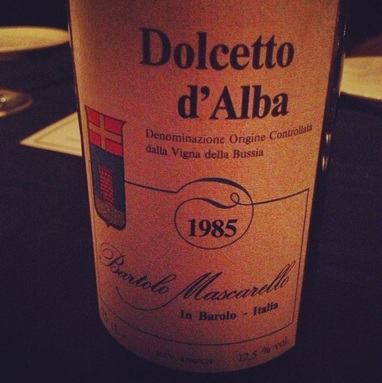
<--- This was a fun little surprise that was thrown in blind at the very end. No one guessed even close to dolcetto, or to the 80s. 

Bibliography

Handler, Richard and Jocelyn Linnekin. (1984) "Tradition, Genuine or Spurious." Journal of American Folklore. Vol. 97. No. 385.  

Hannerz, Ulf. (1989) "Culture Between Center and Periphery: Toward a macroanthropology." Journal of Anthropology. Vol. 54. Issue 3-4.  Pp. 200-216. 

0 Comments

Third Shift Amber Lager (TX & OH)

8/2/2013

0 Comments

 
Picture
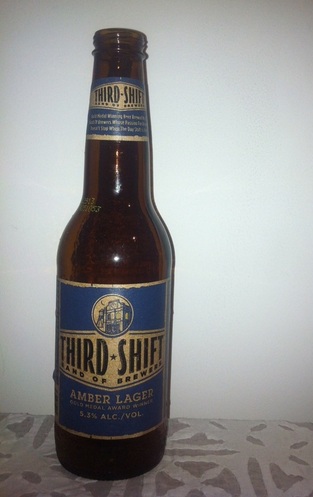
"Third Shift" is an interesting study in marketing. 

This beer is brewed by a company within a company. MillerCoors created "Band of Brewers" who make "Third-Shift" beer as an attempt to compete in the market with the craft beer movement, which has been gaining momentum over the last decade. 

When you look at this beer in the cooler of the beer aisle, it stands out. The label is brown paper with navy blue ink; it doesn't shine like the other "Big Beer" company bottles, and the implicit design to appeal to a select group of blue collar workers is so simple and clear that it is borderline offensive.  

At first glance this appears to be a craft beer, but I was suspicious when the label mentioned that it was produced in two states, and when I couldn't find any real information about the "Band of Brewers." What were their names? How did they start their company? The story seemed like empty sentences dreamed up around a marketing brainstorm meeting. The label implies that the "band" works past the day shift into the night to bring us this beer; but if that is truly the case, shouldn't they be able to start sleeping again at night now that their beer has sudden, over-night distribution across the US?

Read more about it here. 

This is an interesting example of the paradox in which "Big Beer" finds itself. Most small companies striving for success want to appear bigger than they are, and most companies build up their brand and depend on it. Big Beer finds itself in an opposite quandary. With the unexpected turn of public favor shifting against Big Beer, each major company is creating sub-brands and mini companies within the parent company. These smaller "breweries" use the same facilities and infrastructure to market, but they must appear to be struggling start-ups to garner public support.  

Who would have thought, fifty years ago, that one day a successful corporation like Coors would have to take steps to mask its own brand in order to sell beer. 
0 Comments
Forward>>
    Picture
    _

    Erin

    I’m Erin, and I believe that beverages, culture, and history bring us together. Here, you'll find information about wines from around the world, and Virginia.  


    Top Posts

    Elizabeth Bird
    Sommelier History
    Stars & Terroir
    Dry German Wine
    1962 NYC Wine List

      Want to subscribe?

    Submit

    Archives

    September 2025
    March 2024
    February 2023
    December 2021
    May 2021
    June 2018
    October 2017
    September 2017
    August 2017
    July 2017
    June 2017
    April 2017
    March 2017
    February 2017
    November 2016
    October 2016
    August 2016
    July 2016
    June 2016
    January 2016
    February 2015
    January 2015
    December 2014
    November 2014
    October 2014
    September 2014
    August 2014
    July 2014
    June 2014
    May 2014
    April 2014
    March 2014
    February 2014
    January 2014
    December 2013
    November 2013
    October 2013
    September 2013
    August 2013
    July 2013
    June 2013
    May 2013
    April 2013
    March 2013
    February 2013
    January 2013
    December 2012
    November 2012
    October 2012
    September 2012
    August 2012
    July 2012
    June 2012
    May 2012
    April 2012
    March 2012
    February 2012
    January 2012
    December 2011

    RSS Feed

    Picture
Powered by Create your own unique website with customizable templates.